


In the Bacardí offices at Tultitlán, north of Mexico City, your eye is drawn towards the garden. A short walk away, in the bottling hall, you look up. Since returning from Mexico, I have often thought about those two gestures and the decision that made them possible. In the late 1950s, Bacardí commissioned Ludwig Mies van der Rohe to design its offices and Félix Candela its bottling hall. I would have liked to hear the conversations in which those commissions took shape. I wonder how much of what I saw at Tultitlán was already there in the words the client chose.
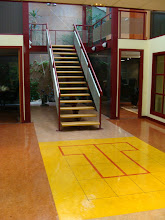
Mies built a pavilion of steel and glass. As you climb the travertine staircase, you leave the double-height entrance hall and arrive on an office floor where furniture and tall timber partitions give each work area its place. When we explain the open plan to our students, we tend to draw the columns that make it possible. For someone who spends much of a working life there, that freedom can also be measured from a chair. Where does the partition end? Whom can you see from your desk? And when you lift your eyes from the page, can you see a tree?
Beneath Candela’s vaults, I find myself looking up with the eyes of someone who has spent half his life on building sites. Each vault spans thirty metres, although the reinforced concrete shell is only four centimetres thick over much of its surface. What moves me most about those curves is the thought of the carpenters who made the formwork for them out of straight boards. Somewhere between the geometry the architect draws and the board the carpenter sets in place lies one of the reasons I still love this profession.
If I were to imagine the one page of the brief that both architects might have received, I would ask for room to work comfortably, daylight for the people who spend their days there, and as much care for the place where the bottles are filled as for the room where the directors meet. Then I would leave each architect to draw. Perhaps the client, too, has a share in the authorship of a building. It takes a particular kind of curiosity to say clearly what you hope architecture can do and then wait to see where someone else’s answer might take you.
In a history of architecture, these two buildings could easily end up several chapters apart. Mies has his chapter, Candela his. At Bacardí, someone could leave the office with a few papers in hand, cross the garden and step into the bottling hall to speak to a colleague. I like to think about that walk. It gives the two buildings back something that photographs often leave just outside the frame. After so many years spent caring for built heritage, if someone asked me what was worth preserving at Tultitlán, I would point to that path as well as to Mies’s steel and Candela’s concrete. You have only to walk it to understand what one client made possible by placing its trust in two architects who saw the world so differently.




No hay comentarios:
Publicar un comentario